I think the quality of engineering talent at Space X is probably higher. Having lived with and met a couple of Tesla Engineers, they seem to optimize for ability to work insane hours and accept lower salaries. The result is that Tesla does not have as many people from top engineering schools. This probably doesn't apply to early Tesla employees who seems much more qualified.
I'm sure there is a reason for this and it might be a better approach for scaling production.
I managed in Silicon Valley for about ten years, and did the university recruiting rounds every season to find people. I probably met and sceened around five thousand university students during this period.
There really IS a difference. The quality of the candidates from top schools -> mid schools -> mediocre schools is very observable.
It's only observable in right out of college. You're less likely/wouldn't notice if you had two candidates with 10 years experience. Which is why companies go for people fresh out of school. Their naiveté gets them accept lower pay and work longer hours.
It represents kind of mindset. If early on in life(13-14 when grades start to matter)you wanted to excel in education and are willing to go to a top university where you are crushed with workload, it demonstrates a sense of drive and passion. You definitely can have that same drive and passion and go to a very mediocre school, but there are less of you statistically. you may even have more self-discipline since you must go above and beyond you peers, but from a recruiters perspective, when they are looking for top applicants it becomes a statistical game really fast.
I completely agree, the guys going to top universities worked hard in school and got good grades. They were high achieving children. They're good at exams. They were probably also relatively smart, and probably also somewhat privileged.
Now, to what extent that translates to "being good at the job you're trying to fill" - that's the interesting question. It'll generally be relative to the biases of the people doing the interviewing and their personal experiences.
Right, that is why companies like google and Facebook who do a ton of research in hiring play such an emphasis on academic achievement, especially in younger employees.
I think saying that being good at achool doesn’t make you good at your job is something we say to make ourselves better.
You can’t be good at your job if and only if you do well in school, but if you do well in school, especially at tough universities, chances are you will be good at your job.
Seems right for the wrong reason. Not because of the education, but the types of people who would be very enthusiastic about getting into SpaceX would be a different kind than for Tesla. I did meet a couple of early Tesla folks and they did seem to work insane hours for lower rates due to the company name.
I only know one Space X engineer (who went to UC Irvine), but I from what I know from him they're also paid lower than market rate as well as expected to work >40 hour weeks regularly.
edit: he went to Irvine, not Davis, edited original text.
It is my impression that things have been changing at SpaceX over the past couple of years. No doubt they are demanding to work for, especially if you are in the direct path of launch deadlines, but as the company's grown they also seem to be paying more attention to things like work-life balance.
I wish I was this cynical to ride people hard at a 20% pay cut and in exchange offer them the privilege of making me another billion dollars. It's good to be the king.
In my experience, that's inaccurate. Certainly for the majority of interns, but 50-60 hours is the range I would say is accurate on average. Obviously, there are some weeks with a lot higher, but they're relatively rare.
My understanding is that they value people who are passionate about Tesla and SpaceX products. The logic is that if they truly care about what they're working on, work-life balance and pay can be sacrificed. I know several people that sometimes complain about the long hours at these companies, but they refuse to leave because of their passion.
Sane people are passionate about being able to make enough money to live comfortable for a very long time regardless of them, for example, being fired or company going out of business when Uncle Sam's teat are no longer available to suck on. This has a major side-effect: these people's interest align with the interests of the company as a business.
If you can send a building into space, land it on a postage stamp floating in an ocean... I have high-confidence you can solve production line scaling challenges.
Yes, that's why the Soviet Union's lead on space in the early 60s translated into abundant production of consumer goods. Ladas all over the place.
Making a spacecraft work and making a production line work are completely different problems, and there's little reason to think that an organisation good at one is necessarily good at the other. I'm not saying Tesla WON'T sort out their production difficulties, necessarily, just that it doesn't follow from SpaceX being good at space launch.
USSRs problems weren't that they couldn't make production lines work they were extremely good at manufacturing at scale.
The problem was that they were really bad at figuring out what needed to be made and at what amounts because of the worst kind of planned economy you can imagine (take aby soviet era product hammer, clock, lock, radio w/e and you'll see a very peculiar thing a physical price tag embedded on it, if you were a factory you were basically told you are making X now, price, profits and all economic decisions were taken out of your hands).
If anything their problem was that they produced way too much of pretty much everything on a whim.
Additionally there was all the wrong kinds of competition in which the establishment was the selective force rather than the market.
They also had problems enforcing quality requirements across different organizations. Aside from the military, it was impossible for a downstream organization to reject the output of an upstream supplier for low quality or non-conformance to spec. Hence each organization was incentivize to produce at as low a quality and at as cheap an interpretation of the central plan as possible, practical usefulness be damned.
Hence not just producing goods unsuitable to demands, but also shoddy build quality for anything that wasn't military supplies.
That was an outcome of having "factories" rather than companies you could have be making razor blades on Tuesday and radios on Friday.
Employment was also non selective you went to school, got your engineering degree did your thesis on jet engine blades and then sent to a factory across the country making mailboxes
Many of the design decisions of Soviet era engineering are becuase of these conditions stuff was designed with high tolerances because it will likely be produced on repurposed tooling not design for it by people who'll be trained every 2 weeks to make something else.
It was more core to the system than just the factories/companies distinction. If you allow downstream consumers to refuse products, and penalize upstream suppliers if their output isn't usable, then you have a market system, whatever label you want to attach to it. (Even if it does not include private ownership!) A functioning planned economy, on the other hand, has to encode all of these requirements in the central plan, which Soviet and Eastern Bloc experience suggests is computationally and organizationally infeasible.
In the limit, a central plan that works well is going to contain a detailed simulation of something that looks like a market economy, with rational actors modeled out at every step.
Turns out that at our current state of technology, doing that isn't feasible yet, but that may change at some point.
Eh, not necessarily. Markets don't find the optimal solutions for every problem. Look up "Price of Anarchy" in game theory. I don't claim that it's feasible to come up with central plans that beat markets, but there are cases where central planning can produce objectively better results.
Except that once you plan hits reality, the rational actors in the real world can look at the plan and change their behaviour to take advantage of it to serve their best interests.
It's like creating a fixed plan for each move in a game of chess where you can't change your game plan once the game starts, but your opponent can and also gets to see your plan at the beginning of the game.
No, it isn't like that. What GP is most likely suggesting is central planning done second-by-second, not year-by-year. Think less "government decrees" and more "closed-loop feedback control".
I suppose there exists a Nash equilibrium, where every actor can't act in a way that will decrease the effectiveness of the plan. Problem is that it's way too computationally expensive to calculate one for a 10 player Hold'em poker game, let alone an economy with millions of decisions and actors.
This isn't unique to the USSR however. There are similar weapons in the US arsenal (M2 Browning for example) that are so well designed that is still in service 84 years after initial introduction.
Back when engineers had to use slide rules, and metallurgy wasn't as sophisticated, designers had to over-engineer machinery (and buildings, and bridges).
The Khrushchev and Brezhnev-era USSR had a fantastic understanding of what needed to be made. Refrigerators, radios, televisions, washing machines, vacuum cleaners, and automobiles. Things that the public very clearly wanted, and that politicians were very clear about the public getting.
All of those things were consistently under-produced, and never met their quantity, or quality quotas.
And that is the problem, politicians were keen on building a TV.
You couldn't just build a TV there would be a great design competition and then a design will be selected.
The selection will be political which means that designs were not selected by market forces which favor merit but rather the whim of a corrupt and inefficient political machine.
The pricing also was an issue, economics in the USSR were screwed it was socialism bubble in a capitalistic world.
Everything had a price but the price was completely detached from the cost and the value of the product (the designers themselves could not gauge the true costs of their designs, and quite often the design that would keep as many people
employed would be favored which would cause even more inherent inefficiency)
When your TV was priced at 50$ but cost 500$ to make there will be shortages.
Additionally the USSR had a horrible problem with skilled labor despite probably having one of the better educated workforce in history.
This was because again lack of meritocracy and a free market a rocket engineer would be making as much as an engineer working on bicycle gears.
Unless you were well connected politically you also had very little choice on where would you be assigned to work.
Because of this building skills in critical industries in the commercial and consumer sectors was very hard.
There were different appliance manufacturing companies in the USSR, and consumers very clearly expressed their preferences. Different Soviet brands commanded different prices, and had different levels of demand for them.
Pricing was an issue for different reasons - some people had money that they couldn't spend, whereas other people had very little money. Food and housing were heavily subsidized but goods weren't, wages for different professions were very different (And rarely reflected the social/economic value of their work.)
It wasn't some communist paradise where everyone was equally poor. There were absolutely class and wage distinctions. An engineer building rockets was getting paid more, and had access to better stores (And priority on high-end consumer goods, that were less, or not available to the public) then one building bicycles. One way to be 'politically connected' was to work in an important industry (Specifically, defense. Being a senior manager also qualified.)
The Soviet rationing model rewarded both political parasites, and successful people[1]. A bit like 'meritocracy' works in many Western corporations, if you think about it.
The serious problems in the Soviet economy were the absolutely insane military spending, corruption, bureaucracy, theft, inconsistent accountability, and extremely conservative commandments from central management that strongly discouraged, and sometimes punished innovation and optimization.
[1] Unless you were a kolhoznik, or serf, tied to the land, a political problem, had relatives who were political problems, were one-quarter Jewish, etc.
That not true. Ph.D. in University was making the same wages as cleaner working in said University. You underestimate how ridiculous was communism. My parents after getting Masters choose to go into farming as it was better money.
Everyone has plenty money but you could not buy anything, you needed a special token to buy for example new fridge. Used products were more expensive than new. You needed to wait for everything.
People did not revolt because of propaganda and in a technological leap that happened after the war. In 1950 you will still go to the city on the horse but in 1980 everyone had running water, TV, electricity and at least a one car per village.
I visited the Czech Republic while they were still communist. The most hilarious thing I remember was a price stamped into loaves of bread. It appears they had official price brands distributed from a central point, since they looked the same everywhere. This means the price was probably unchanged for long periods of time.
Prices for most common goods (especially food) were fixed by the government in Eastern Bloc countries, usually they stayed the same over decades. The quality, especially for imported stuff (like coffee) could vary drastically, but the price stayed the same. For 'bread buns, rolls' (or whatever they are called outside Germany) the price in Eastern Germany was fixed at 10 Pfennig since forever, and it was commonly called a "10er Semmel" because of this (or a "fiver" for the small version).
I’m finishing up school for a Manufacturing Engineering degree. It’s frustrating when people look down on the degree due to a lack of appreciation. So many people are so far removed from manufacturing that they think a company simply walks into a store, buy a few parts, and put them together just like a consumer would when in reality there’s an entire discipline dedicated to figuring out how stuff should be made.
I graduated a couple years ago from Iowa State with an Industrial Engineering degree. Totally agree on how little most people understand on production issues. There's so much that goes into setting up a high volume assembly operation. To name a few:
* Bottlenecks are always being addressed. If you spend your time anywhere but the bottleneck operation, you're not increasing the capacity of the line.
* Quality issues can call back thousands of units and kill production for an afternoon. Hopefully the quality department catches everything, but without 100% testing they will be missing things. 100% testing of everything would drive costs up an insane amount, so sampling is done. Bad product slips through sometimes.
* The labor resources need to be effectively split so everyone is doing their task for the same period of time on the assembly line (and sub-assembly lines).
* Workers need to be trained and qualified for the positions they're doing. It could be as easy as 5 minutes of training on the new job content or as much as sending people to a training program because you can't hire the labor trained already.
* Fork truck drivers running into things can shut down an area during the accident investigation, preventing the typical restocking path (which is also finely timed out). Fork trucks run into things way more than most people would guess.
* Some production equipment breaks requiring unscheduled downtime. If you have redundant systems, you need to prioritize which units get processed next. You're already almost guaranteed to shut down production if you're running a lean operation.
* A supplier misses a delivery deadline. Especially on large assemblies like a car, you can't easily do more assembly and then add the part later. There's an order everything has to be assembled in. Yeah, you get to charge the supplier a shutdown rate, but that won't make your customer happy.
> This is a common challenge in lean manufacturing. Holding inventory is expensive in many ways, but having 0 on-hand inventory means every minor production hiccup is felt. Finding a balance to make supply chain, production, and management happy is a challenge.
* The sales people sold a product or feature which doesn't currently exist, so between design and production you've got to figure it out. Suddenly the line which was going to be streamlined with minimal product variety has 35 possible combinations rather than 4 and you have more logistics to deal with.
* A supplier abruptly stops supplying one of the products you are purchasing from them. You have 1 month to figure out a solution, send the trial runs through quality, write the work standards, etc.
* Procurement requests that a slightly different part is used from a supplier because it will save 5 cents/unit. Over 1,000,000 units that's $50,000 in savings. Do that on 15 parts in a big assembly and you're saving real money.
* The marketing campaign was more effective than anticipated, and demand for the next 3 months rose 25% (rather than the 10% boost anticipated). You now have to bump the production rate up an extra 15% which changes all the work instructions and line balancing, redo some workcells to allow for the increase in labor, increase traffic and congestion with the material handlers, buy/lease another fork truck, etc. There's a cascading effect. There's software which helps with the line balancing and possibly some of the internal material handling, but there's still some manual sanity checking of it all.
* The business is doing an IT transformation which can require anything from new/more computer systems on the line to completely retraining all of the staff on how to enter orders and production tracking into the system. Mentioning an ongoing Oracle installation will elicit condolences and heightened blood pressure from anyone who has been involved in one previously. I've seen Oracle implementations literally cause production employees of 20+ years walk off the job.
* The facility you're working in is land locked with no neighbor being willing to sell you land. Over 50+ years production lines were added, reconfigured, and removed. Shutting production down for 30 days to redo "everything" will cost tens to hundreds of millions of dollars and is only considered every decade or two.
That's a generalized list of issues I've seen while full time and on internships in a variety of industries.
I'm a Materials Engineer that works in an industrial plant (Steel Mill). Similar issues in this line of work.
Latency is a huge issue here. What you put into the Blast Furnace can take 8+ hours to propagate through. So when you are trying to react due to a quality issue can take a long time until you see the effect of the change you've just made. Online modelling and process simulation plays a big role here.
Supply is an issue as well getting an ore/coal shipment in can have 20+ day lead time. These boats are huge can take days to fully discharge them even things like docking space on the berth needs to be optimized and appropriately scheduled...
A lot of people can't grasp the sheer scale of our operation it is one thing to read a number on a page and another to walk the length of a conveyor and see what 500 Tonnes Per Hour actually looks like as it is going past you...
I've also worked in an "insane scale" plant and totally relate. I've been in two facilities where it took over 5 weeks to get product through from start to finish. One made big things, one made small things. Literal square footage to store stuff is sometimes the reason you cannot produce more stuff. Some items have 2 month lead times, which really slows down the ability to move fast.
I think most people could look at one aspect and determine a fix for when that isn't working well, but it takes much more to understand how the whole system reacts and how to keep production going reasonably well.
There could be, but you've got to remember they're often used in heavy industrial environments. Whatever solution would have to be...durable. They aren't treated gently. You have collision risks on the ground (people, guard rails, other vehicles, equipment) as well as above (loads falling before or during a collision).
For safety, you have engineered controls and managerial controls (if I remember my training right). Engineered would be a system like you mention. The beam noted below is managerial. Engineered prevent the issue, managerial try to mitigate the issue (but it can still happen if procedure isn't followed).
Lots of the danger is caused by the lack of visibility forward. You'll actually see forklifts driving "backwards" a lot of the time. They can turn their head/back around and see almost full visibility.
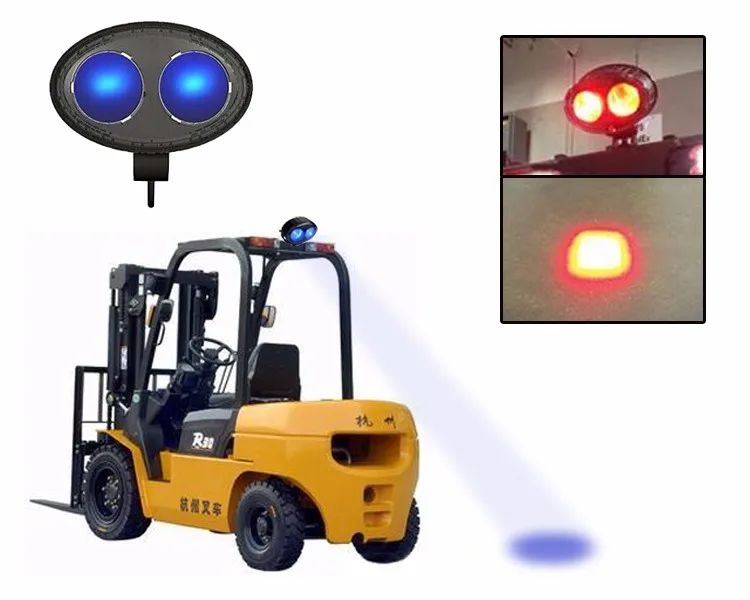
There are lights like this on many forklifts. They shoot a beam forward ~15-20 feet in front of or behind a forklift. They are super helpful for knowing where a forklift is before you turn a corner. https://sc01.alicdn.com/kf/HTB1nkQ0LFXXXXazXVXXq6xXFXXXx/202...
Mobile equipment injuries are often the largest reasons for First Aid's, OSHA recordables, and deaths in stereotypical "industrial" factories.
Thanks for the feedback. I'll throw some more down below.
Factories to me are like software to software engineers.
* Complicated systems with certain requirements to meet (transactions/second | units/day)
* Uptime requirements (99.99% for some web services | 70% is great for really old equipment)
* Budget requirements (dev time cost | cost per unit)
* Unrealistic deliverables (seamless launch on a production server without testing in that specific environment | 110% capacity scheduled and ignoring the preventative maintenance outages that were scheduled)
* Changing requirements (Customer changed their mind on <major feature> | Marketing wants to launch the new product in 2 weeks rather than 3)
* A variety of demands and sub-optimal conditions (crappy server to deploy on | factory equipment from the 1940's)
* Appearance of simplicity to the uninformed ("UX mockup is done, so the software will be in production next week!" | "Just increase inventory levels and we wouldn't stock out our customers.")
* People with different incentives pulling for different objectives (Non-technical manager doesn't get why code isn't done on time | Production is pissed that Quality won't release a set of parts)
At the end of the day, looking at and understanding the larger system is what makes an industrial engineer or software engineer effective. At first glance it may not seem like doing <x> will make a big difference, but <x> can either be a simple fix that was overlooked earlier or it can mean undoing hundreds of hours of work. That's true in programming and on the factory floor.
# Other IE Things
ERGONOMICS: Haven't even mentioned that yet. Workplace injuries often fall into an IE/mfg eng. role as well. Rather than doing the exact same thing all day long, it's not uncommon to switch jobs with a coworker after 4 hours. This gives the muscles required for Job #1 a chance to recover and repair before they're damaged too much. Doing the same thing all day can lead to repetitive stress injuries (and is simply more boring).
Fixing Drawings: Lots of times the prints (part drawings) will have assumed tolerances such as +/- 0.01" for lengths. If the designer simply marks "18 inches", it must be 17.99-18.01". To achieve that on cutting stock material to length will require some pretty good measuring. If it would function fine at +/- 0.5", the cost of production just decreased significantly. Throw it into the bandsaw and quickly confirm with a tape measure and move on. Tolerances should be as loose as possible to still allow for full functionality of the part/assembly. Going any tighter than required drives the cost up very fast. This is a common battle between manufacturing engineers and mechanical/design engineers. At Iowa State the mechanical engineers were briefly introduced to Geometric Dimensioning and Tolerancing (GD&T) around sophomore year while the IE's had ~1/3 of a class focused on it. There are thousands of ME's who know nothing at all about tolerancing and are making products more expensive because of it. I'm kinda passionate about this one. Tons of stuff has horrible tolerances
Order Quantities: How many of each part should be delivered from suppliers? What's the economic order quantity? [1] We have formulas for some of the more straightforward questions in this area, but things can get more dicey with something as simple as a bulk order discount. Is it worth ordering a bit more to get a price break considering the additional warehouse space required? That little modification makes the decision much more difficult.
Part Presentation: How will everything be presented to the assemblers on the assembly line? Just the orientation of a part can have a big impact on how fast something can be assembled.
Assembly Assistance: How will the parts be held during assembly? What can be done to make the assembly faster? Not threading the entire length of the bolt, tapering holes so screws drop in almost effortlessly, jigs to hold the parts, dummy-proofed systems so the parts physically cannot be assembled incorrectly, reductions in the number of pieces, etc.
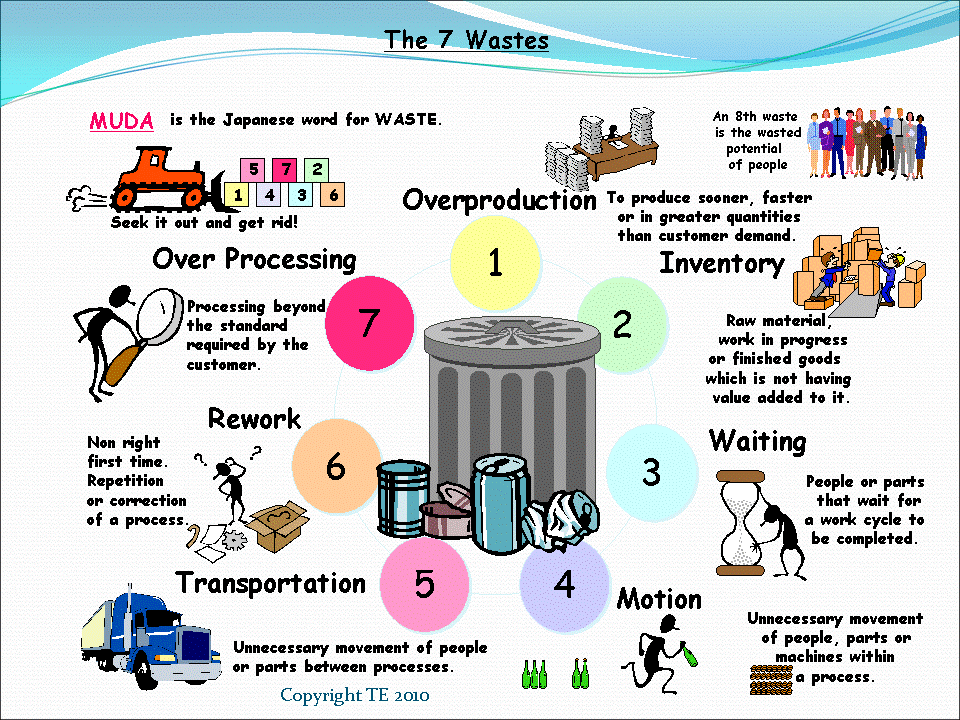
Reducing Waste: In lean manufacturing, there are 7 wastes: Overproduction, Inventory, Waiting, Motion, Transportation, Rework, and Over Processing. [2] Reducing or eliminating these has a substantial impact on profitability. If you have a 5% profit margin on widgets and you scrap a widget, you just wiped out the profit from 19 good widgets. Bad quality is expensive.
Project justification: We have $40 million available for CapEx. What should we do with it? We have a set of possible projects, what combination will get us furthest towards our overall goals? What's the payback time on the investments? If it's more than 2 years, it won't get approved in most companies. The 2 year ballpark changes based on how conservative the company is and the overall economy, sometimes dropping to a matter of a few months for full payback during recessions. These calculations involve working with finance and accounting to determine the value of investments taking into account wage rates, overhead, cost of the project, and the discounted cash flows going forward.
Optimization: Is the way we're doing things mathematically optimal? As my professor put it, you want to run your system optimizing on profit so that a competitor cannot come into the market, get all the same suppliers and deals, then beat you on profit or cost to the customer. Pages 3-14 of this presentation demonstrate the introduction to optimization accompanying his explanation of why it matters. [3] Additional sets of slides available at [4]
Produce in-house or outsource?: Outsourcing can sometimes mean a company which specializes in that particular type of part will make it. This can reduce cost because your company doesn't have to be the subject matter expert on everything. It's also harder to get a response from a vendor regarding a quality issue than someone inside your same company.
# The "E" in IE
Finally, to refute an argument I've heard too often, IE's (at least from Iowa State) are not basically business majors. I had more practical business info thrown at me than an Aerospace or Mechanical engineer typically would, but the coursework is largely similar to other engineering programs.
There are programs I know of in which IE's are glorified business majors, but the Iowa State program is "Industrial and Manufacturing Systems Engineering". ISU and Penn State in particular have a strong manufacturing emphasis. During undergrad, ISU IE's took Calc 1-3, DiffEq with laplace transforms, thermo 1, chem 1 (no lab), physics 1 and 2, materials engineering 1, and statics. Beyond that the engineering majors typically diverge into major-specific content.
For us, that includes classes on optimization, ergonomics, engineering economics, material removal processes (machining mostly), solidification processes (casting and injection molding with an awesome hands-on lab), engineering drawings, production systems (order quantities and stuff like that), stochastic systems (includes some factory simulation), quality assurance, and a rough 200 level calc-based statistics class.
I hope putting the info out there a bit more will make people more aware of the breadth of what we work on. I'm more than happy to answer any other manufacturing or IE questions.
You did a lot better job of expressing my thoughts than I did. I wrote my original comment for this thread in a hurry. I had a short lunch because one of our suppliers gave us a shipment of parts that were all out of spec. Management told me to keep the parts since they would get a discount on their next shipment if they kept these bad parts for production. Using these bad parts caused more rework than we’re saving. Buuuut I’m just ranting.
Back in my school IEs are called “Imaginary Enginners.” So they made shirts that said “We may be Imaginary Engineers but we’ll be your boss someday.”
No problem. It's probably analogous to showing an end user a UX mockup and then them changing the whole scope of the project and expecting it done in 2 weeks since the whole thing is basically put together. There are lots of changing demands and the system designer (manufacturing engineer or software engineer) is trying to not piss people off too much while achieving the overall goal.
I am putting together a few more examples in a sibling comment right now.
What's the usual sourcing process for large amounts of components? word of mouth? suppliers cold calling potential customers? how does company x that manufactures product y get in touch with part supplier z?
In the organizations that I’ve worked at (around 100 people), sourcing is done by the purchasing department. After some quality engineers give the green light on a few shipments to make sure the parts are good, the vendor is trusted and more of their parts can be purchased. Manufacturers usually try and stay with the vendors they have for parts because the vendors are trusted to give quality parts, have relationships, and lines of credit already established. Basically reduces risk of getting junk and investing more time and money to find something that works.
If you subcontract production, the service provider typically has supply chain specialists that source things on your BOM. Procurement people might do direct purchasing/negotiation (typically on special&pricier bits), or go to wholesalers for mass consumption items.
It was not the sole failing, but it was a big one. None of the light-industry (Consumer goods)-focused 5-year plans managed to have any positive impact on production.
In fairness, SpaceX is going to have real production line issues of its own to sort out -- how many landed rockets do they have in warehouses now waiting for refurbishment? Both companies are going to need to get good at this.
SpaceX already has one of the highest-volume production lines for boosters, upper stages, and fairings. They've got a lot more work to do, of course, but they're already done challenging things.
Ultimately, abundant production of consumer goods is an engineering and planning problem. Throwing a bunch of smart engineers at a clear goal will almost always solve the problem.
Maybe Russia just forgot to share progress downstream and kept space tech under military secrecy ? Or maybe too much resources allocated to space and none to the rest of society.
Different set of skills needed. By that logic car manufacturers should hire the people who designed the Curiosity Rover to run their manufacturing lines. This won't work.
Their launch rate was previously a struggle, but they have hit their stride this year with 13 launches in a little over 8 months (they had 7 launches in all of last year).
My uncle, being in Mitsubishi car manufacturing, he is specifically responsible for sheet metal and paneling. Heard him mentioned ways for non-destructive damage detection, with Ultrasound, X-ray, and good'ol knock-and-listen being the prominent choices, I am quite surprised to hear Tesla needing to call in rocket scientists.
I guess it must've be that specific context that prevented them seeing the solution.
It's marketing. "Tesla, made by rocket scientists" is the message they want to implant. Musk does a lot of that kind of thing, like the mock 3D gesture controlled CAD rig [1], or the Jetsons manned rocket [2].
It's smart and good salesmanship: Figure out the coolest announcement you could make, then work backwards from there and make it happen.
I doubt it, they all face far too big of a risk from a financial downside perspective with little to gain other than slashing "corporate overhead" - read redundant positions in things like HR and accounting.
On the flip side, if Space-X has a couple of failed launches and loses one or two contracts, their debt would crush Tesla. And vice versa if the 3 doesn't take off like Tesla is hoping.
There's almost no risk to them sharing IP between the two companies. And given how tightly they're intertwined from an ownership perspective, I would imagine that will continue indefinitely.
And it is possible to get waivers for particular individuals. However, because of the process involved, it is unlikely to be pursued by someone like SpaceX except in very exceptional cases of getting known international experts.
I wasn't talking about green cards. I was talking about "non-US" persons. In other words, I was adding additional information to your comment, not contradicting it in any manner.
I think their financials are already fairly intertwined, to the point where if one fails, they all fail[1]. Part of the outrage over the SolarCity purchase was that people were worried that Musk was just trying to bail out SolarCity (solar was and still is going through a bit of a downturn).
A company that is similar in practice is the giant Samsung. They make electronics, military equipment, ships, missiles, medical equipment, etc... they even make some basic technology for space rockets and cruise missiles. The only thing they don't or can't make is the stage 1 launch system which the US prohibits them from developing and they instead purchase it from Russia.
The Samsung family are geniuses at running complex operations, but their basic operations are heavily assisted by other companies and people from other nations.
Musk on the otherhand is kind of like the Trump of America's advanced technology industry with the illusion of a heavy liberal bent. His focus is on more of a "white" company, being South American and having escaped from the abolition of Apartheid, he fits in well with what the majority of Americans are looking for. However, the expectation of him being a "white US" friendly operation prevents him from adequately recruiting the needed personnel to run a conglomerate.
edit: I understand that some of you are finding it difficult to process how Musk can run companies that appear so attractive, yet ignore its cultural and political structure. It doesn't matter economically. Economically, all that matters is what you perceive of his image and thereby the company(s) whose image you believe-in from what you think you understand of Musk.
What works in the US and Europe is to develop a latent "white supremacist" image with a strong undertone, without any direct overtures. The only difference between Western liberalism/democracy/etc... and Western Fascism/Racism/Consveratism etc... is how the basis and execution of this idea of supremacy is viewed and communicated.
I downvoted you because you made baseless accusations of industrial scale racism not only at Musk but at all of Western Civilization. I'm not saying there are no issues with racism, but to say "hiring lots of white people and not using Indian contractors" is equal to "white supremacy", then you are WAY off base.
Uh, I seriously doubt Musk gives two shits about his "whiteness," whatever that means. SpaceX can't hire non-citizens because of ITAR regulations. So no armies of Tata consultants and other H1B mills.
I'm as big a fan as the next guy, but did anyone find the breathless tone progressively harder to tolerate? Whatever happened to just stating the facts.
I'm kind of of the philosophy that you aught to train yourself to extract the facts on your own. You're unlikely to change the trend and it's a good ability to have in situations other than reading the news, like in conversations.
Going to need some pretty advanced AI to prefab human living spaces and life support as well. Not only would 480k ms ping be murder on anyone trying to drive ground vehicles but if you're going to be trying to build deep underground autonomous would probably be easier than laying cable.
I wonder if this happens between other companies even less related.
Would two companies that did not compete in any way be willing to help each other other out because there CEO's were old-time buddies? Say some chemicals engineers from a big oil company going to help solve a problem faced by a baby food manufacturer?
Another portion of meaningless revelations. Just shut up and do your work Tesla , your bragging about trivial stuff is an insult to normal business and engineering


I'm sure there is a reason for this and it might be a better approach for scaling production.