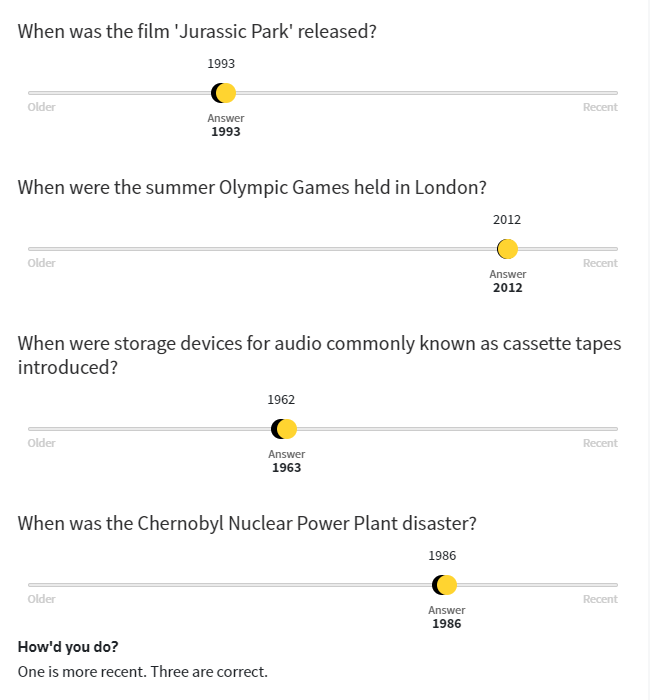
As a musician, I developed a sense of time in my mind, and it expanded to everyday actions and thoughts. Am I the one that did answer the questions correctly?
The date slider section was straightforwardly about 'answering correctly'. If you can ballpark all of these events to the right decade or so, further granularity is unlikely to be related to perceptual distortions about time.
Obvious example: the cassette question.
Question: When were storage devices for audio commonly known as cassette tapes introduced?
Expected answer: 1963.
If "introduced" is intended to be read as shorthand for "sold in a retail market", then this question has no single answer grounded in one person's life experience. I was recalling the year of invention when I answered[1].
Citing "the early 1960s" will be good enough for anyone having a conversation about tech history. The year of the first retail release certainly isn't interesting or worth keeping in your head. Worse, the 1960s weren't even the decade most strongly associated with cassette tapes.
So this is very much a neener-neener type of gotcha question.
Shouldn't the correct answer be "I don't care/I don't know" though? It's always a flaw of those quizzes to exclude the ignorant options. It produces noise in results.
Ask important questions rather than random trivia too. People really remember when they watched a movie, rather than when it was released. When they used a Walkman/CD player/MP3 player/game console, not when they were first made.
I definitely didn't get any "woah time has flown by" from any of these questions. I remembered the correct year for all of them except for the cassette tape which was made decades before I was born. I guessed the early 80ies, thinking of the Walkman, turns out that came out in 1979.
Yes, this. Before my mid-20s, I thought it was just something people said about aging and not an actual phenomenon, but then I started to notice it actually happening. I realized, when you are say, five years old, a year represents a fifth of your life, but at 25, it's a 25th of your life, so maybe it makes sense that years seem shorter the older you get, because they are ever-smaller fractions of your lifespan. Or maybe that's just a bullshit rationalization? I don't know. All I know is that it seems to be a real thing and it just keeps getting worse the older I get.
I equate this to each year being a smaller period of your overall time. When you turned 5 a year was 20% of your life, at 50 it is 2%. Perceptually that is huge.
its more then that i feel. sometimes, suddenly n month/years have passed before you realize it.
its like... it feels something just happened... but its already been 5+ yrs.
for me personally its mostly about routine i think. time just looses its meaning while doing the daily grind.
but honestly, the article spoke about it better then i ever could :)
It's mostly that very few things change quickly enough anymore.
When you're a kid, you change schools, pass exams which serve as time markers, have various important lifetime events. As a young adult, there are a bunch of those too.
You know you're getting old when you start measuring your life by events related to your children or grandchildren.
Older people have fewer of those, especially ones in a stable situation.
I think so too. I'm in my thirties and have lived in three different countries in the last four years. Time feels really linear and it doesn't feel like n months/years have flown by.
I try to always do new things so I don't wake up one day with ten years flown past me.
This is it. It's the same as when one goes on vacation to somewhere new and time stretches way out. As one gets older and time awareness becomes a thing a choice presents itself: how do you want to work with your days? Novelty stretches time, routine contracts it. Time is very possible to "work with", but how well that relates to responsibility is another matter.
The event test at the end seemed to target people older than someone in their early thirties at least. So I don’t know that this article would have anything with being in their thirties to do?
Also, I’m about to hit 30 this year so there’s that.
And also also, when I got to the question about Jurassic Park, my immediate thought was 1993. But then I became unsure whether that was for the first or the second movie so I guessed that the first one actually came out in 1984 or something. Shouldn’t have second guessed myself on that one, d’oh!
But that kind of underlines the point about age, and what they were saying also. If I were older I probably would’ve seen it in the cinema when it first came out and I’d be like “oh yeah, I remember when I went and saw that movie that was the same year that I did such and such so it must have been then”.
I hit 30 earlier this year and I’ve accepted the fact that I can’t hold onto memories as vividly anymore. Even life-changing events that happened last year feel distant whereas when I was younger I could relive memories in my mind, not necessarily with more detail, but they wouldn’t feel as distant.
Time gets really weird when you start introducing chemicals to the brain. Certain drugs not only drag time out, but completely shift the perception to non-linear.
Hmm, not sure the questions about what date a certain event happened feel relevant to the article. I mean sure, people do lose track of how long ago an event really was, and feel like something that happened in the early 2010s was just a few years ago.
But at least in my case, it's more of a subjective feeling, not any confusion about when the actual date in question occurred. I know the London Olympics occurred in 2012, it just feels like 2012 was only a few years ago rather than that the Olympics occurred in some other year.
Still, I'm not sure how you'd really test that in this format.
the sliders are appalling - you click it and the button offsets out of screen - it is impossible to select the correct answer (year) even if you know it.
Cheap Fast and Good does not exists - as can be seen here once again - your cheap and fast approach lost me even though the content might be good. Try some acceptance tests next time before rushing publications.